The Work
Ask for the information that changes the decision
The intake form records the requester, area, location, proposed change, and reason for the request. It separates the expected benefit from potential risks and allows supporting photos, sketches, and cost estimates. That makes it easier to evaluate a request than receiving only an instruction to move or install something.
I included safety, productivity, ergonomics, and other reasons without assuming the category alone proves the request should proceed. A proposed benefit still needs an explanation. A photo or sketch can also expose details about the location that are difficult to communicate in a short message.
Give each reviewer a distinct job
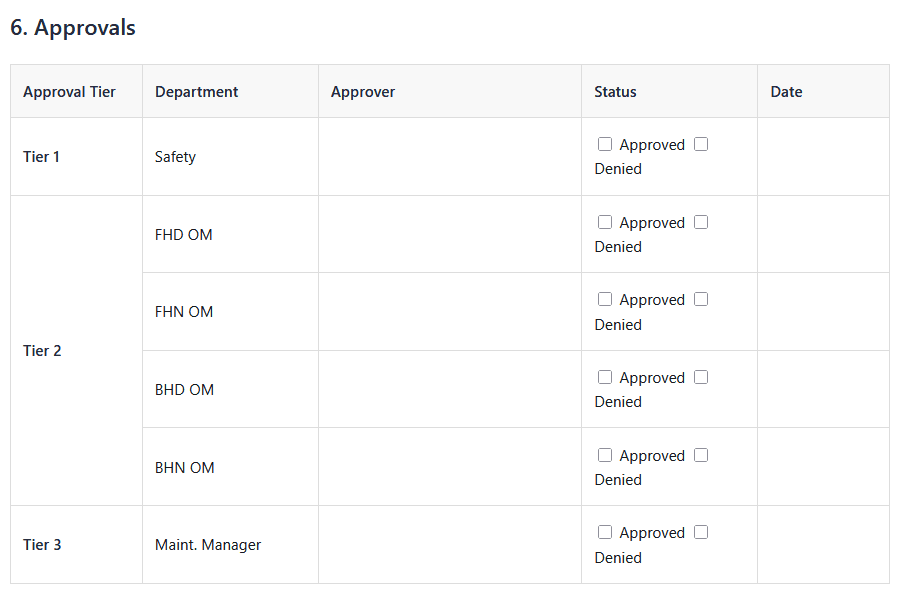
The first tier is Safety, which checks whether the change introduces a hazard or conflicts with safety requirements. The second tier has separate approval rows for four shift Operations managers, giving each a place to record a decision and date. The Maintenance Manager is the third tier, reviewing feasibility, cost, available resources, and long-term maintenance implications.
Each group brings a different constraint. Cross-shift review is particularly important when one group requests a change that another later disputes. The guidelines also ask reviewers to consider whether a change is permanent or reversible, alongside safety, productivity, and cost-effectiveness. That puts the impact of undoing the work into the initial decision.
| Stage | Review question | Record |
|---|---|---|
| Intake | What changes, where, and why? | Proposed benefit, risks, photos or sketches, and cost information |
| Tier 1: Safety | Does the change create a hazard or conflict with requirements? | Safety decision and date |
| Tier 2: Operations | Does the change work across shifts? | Separate decisions for four shift managers |
| Tier 3: Maintenance | Is the change feasible, supportable, and appropriately resourced? | Maintenance Manager decision |
| Decision and closure | Was it approved, and was the work completed? | Decision rationale, denial reason where applicable, and completion/work-order fields |
Keep denied requests in the history too
The documentation package records rationale and supporting material for the decision. Denied requests also remain documented, with a reason. Otherwise the same idea can return later without anyone knowing why it was declined or which concern needs to be addressed.
The form includes a final decision and a maintenance completion area for the work order, date, and notes. Approved changes are communicated to affected departments; the policy also allows a monthly approval summary. These details connect the request to execution and make it possible to distinguish an approved idea from work that was actually completed.
Put a cost around avoidable rework
The supporting cost analysis describes reversals requiring roughly two to thirteen technician-hours before materials, lift use, or operational disruption. It gives event-level examples ranging from about $70 to $300 for smaller reversals and $500 or more for larger work. Those examples explain why reviewing a request first can be worthwhile.
I used those examples to explain the value of reviewing a change before assigning the work. The package gives each group a place to raise concerns, records the decision, and connects an approved request to its work order. Its intended value is preventing avoidable work and making changes less surprising across shifts.
THE DELIVERABLES
What I delivered
- Editable HTML facility-modification intake form and matching Markdown version
- Three-tier approval matrix with separate rows for four shift Operations managers
- Decision, denial-reason, and maintenance-completion fields
- Policy, evaluation criteria, and communication guidance
A CLOSER LOOK
Project exhibits
Record the reason for a decision
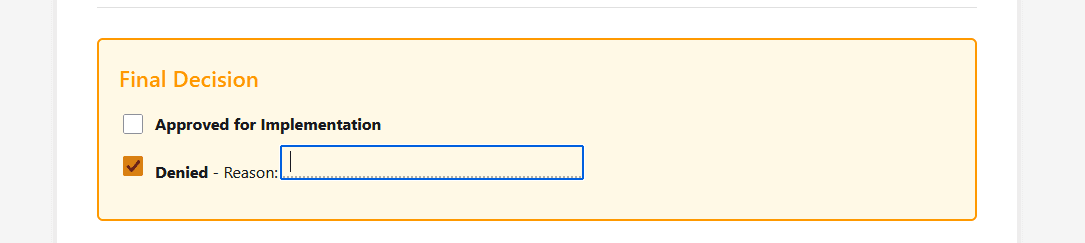
The form includes approval and denial controls, with a reason field so the requester can understand why a change was declined.
THE OUTCOME
Where the work stands
The package gives facility changes a consistent path from request to review and documented execution. It addresses the conditions behind install-and-reverse work.
SCOPE AND LIMITATIONS
What the work establishes
Event-level rework examples are estimates, not a measured annual saving.
The effect on reversal frequency has not been measured.